The Human Domino Effect
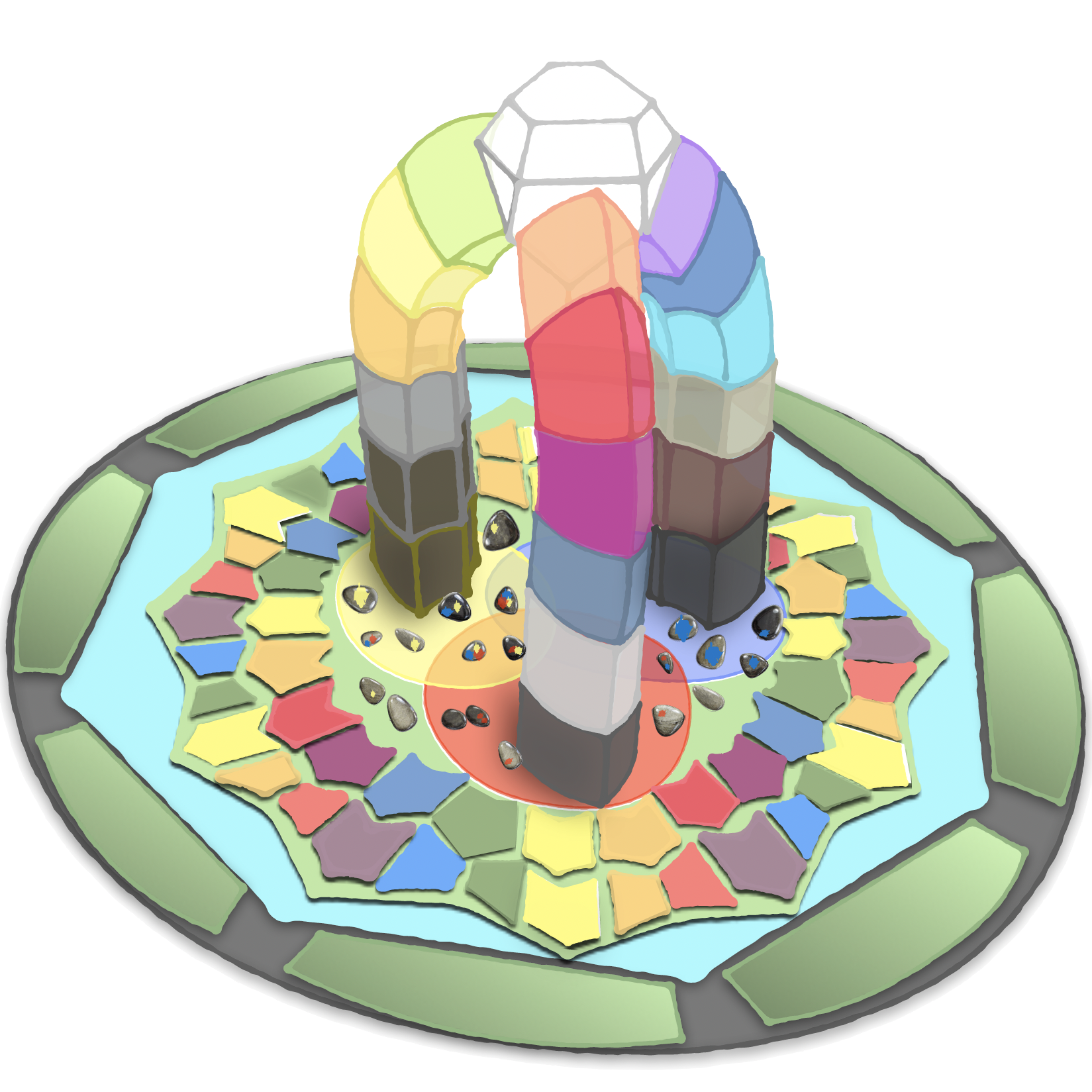
A mental framework of community that helps students better understand that they are valuable members of the human family

Ambassadors
invites you to learn more about each block by clicking one on the board!Our Story

Community Then
There was a time when children and teens could see and experience friends and neighbors working together to make our communities a better place for everyone to live.
While it is true that there were the barriers of prejudice, oppression, and inequality in our collective history, there were also more chances than today for children to see people working together in their village.
Children could see people building houses with each other, growing and harvesting food with one other, and chipping in to help when there was crisis and illness.

Community Now
Community cohesion is not as visible for our youth today, with more of our time spent in separate homes, vehicles, delivery services, and the need to socially distance due to Covid-19.
Children and teens too often suffer from bullies and lack of meaningful opportunities. We have problems we can't solve well unless we all choose to work together with our personal best and a clear understanding of a goal.
When we consider the lessons we have learned as a human family, it seems past time that we stop making the same mistakes that cause preventable harm. Somehow, after all this time, many students don't understand that they're valuable and needed.
Community Going Forward
The Human Domino Effect is a project that involves community partners, schools, and families as they work together to build an online game that reveals what community is and how a well-functioning community can solve big problems.
The game provides a fun opportunity for students to stack up a model with fun building blocks to demonstrate how we are each needed in the process of creating well-functioning homes, schools, and workplaces that combine to make great communities.
Helping students learn the attributes of each building block is a way to respect their individual dignity and brilliance. Then, they can choose where they fit in the movement to make a difference!
The Game
Level One
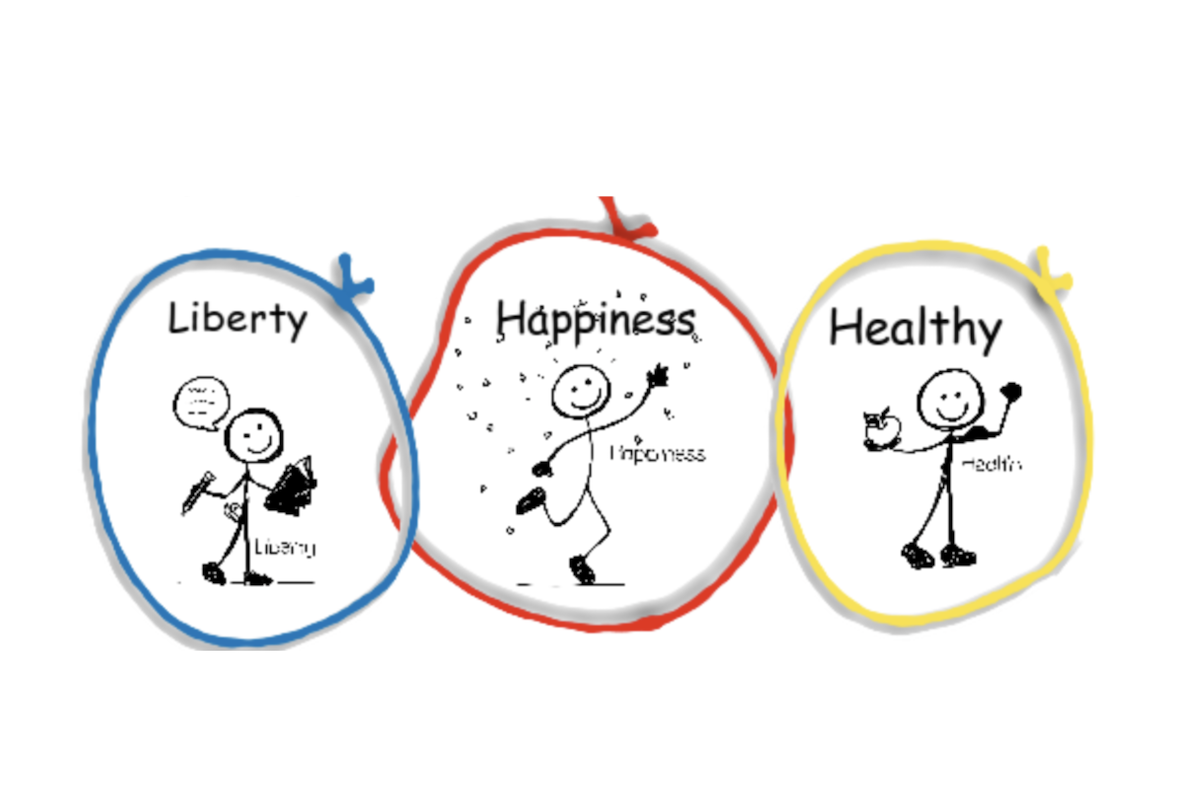
Develop awareness and mutual respect for our own and others' personal health, liberty, and happiness by using the three circle Venn diagram.
Level Two through Four
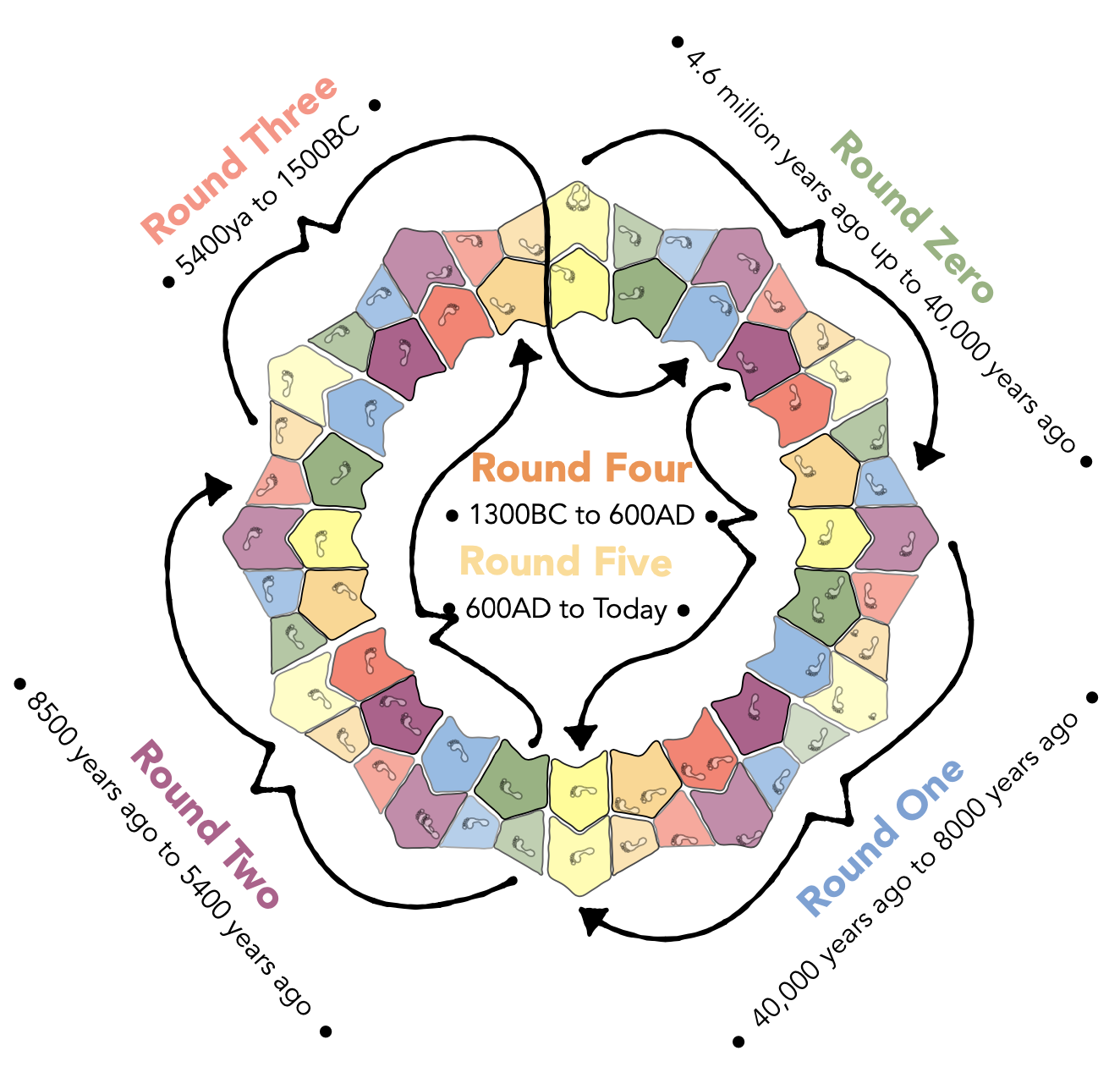
We have quite a human story to tell, and there is a sense of momentum that can be detected in our collective story ... a momentum of progress for good through our advances in the arts, the humanities, and the sciences. Our human story is told through game play with 60 colorful Human Footprint Tiles.

Levels Five and Six
We have learned over thousands of generations about the basic building blocks that help us live happier, healthier, freer lives. Working together to help each other as we contribute to these home and community building blocks increases the benefits for ourselves and other people simultaneously.
Level Seven
Our human story belongs to all of us. Estimates are that 117 billion people have lived on the earth to date, each generation with their own chapter in history. We too have a chapter to write in our human story. Level Seven allows students to come up with ideas that work toward this objective for their own community.
Human Footprint Tiles
Stones, Tribes, Fire, and Beads
- Scientists believe Earth was formed 4.6 billion ya
- Dinosaurs roam our Earth 248-65 million ya
- First stone tools, all humans live in Africa 2.5 million ya
- Neanderthals and Denisovians walk to Europe and Asia 600,000 ya
- Ancient humans make spears and use fire 500,000 ya
- Homo Sapiens, our species, emerges and grows to about 30,000 people 200,000 ya
- Our genetic mother in East Africa gave her DNA to all of us 160,000 ya
- We built the stone circles when all us Sapines lived in Africa and were the same color 100,000 ya
- Some of us Sapiens walk north out of Africa and we make our first beads 74,000 ya
- Sapiens who went North meet up with Neanderthals and Denisovians 50,000 ya
Seeds, Pets, Music, and Fishing
- First sewing needles and we make dogs our pets! 35,000 ya
- Neanderthals and Denisovians become extinct 26,000 ya
- First fishing hooks are created and Sapiens were the only species of human left 24,000 ya
- Glaciers finally began to recede and Sapiens live on every continent except Antartica 15,000 ya
- First battle took place at Jabel Sahaba 14,000 ya
- Younger Dryas caused by a comet makes life for Sapiens cold and difficult 12,900 ya
- Gobekli Tepe is built in Southeast Asia 12,000 ya
- Younger Dryas ended, we survived! Domestication of sheep begins 11,550 ya
- Agriculture began in Africa and Southwest Asia, and dominos are invented! 10,000 ya
- Sapiens built a town called Catalhoük in East Asia and made clay pots 9,000 ya
Horses, Trade, Towns, and Writing
- Copper smelting started in Southwest Asia 8,500 ya
- Our skin color genes began to change and us Sapiens began to be different beautiful colors 8,000 ya
- Many believe our Earth was created 8-6000 years ago 8-6,000 ya
- First kilns were made for firing pottery in South Asia 8,000 ya
- First plant-based cotton made using cotton in Southwest Asia 7,000 ya
- We became food growers and artisans that developed into communities 6,500 ya
- First diamonds were mined in Southwest Asia 6,000 ya
- Sapiens in the Fertile Crescent domesticated chickens and invented the potters wheel 5,600 ya
- Horses were domesticated and the Yamnaya mixed with the Cordedware people 5,500 ya
- Writing letters to make words began in Sumer and Egypt 5,400 ya
Bronze, Laws, Sailboats, and Leaders
- First known leader ruled in Northeast Africa, known as the Scorpion King 5,150 ya
- First chart of the stars was made in Northeast Asia and the first boats sailed on the Nile River 5,000 ya
- Genes for milk tolerance and malaria develop (4000 ya is the same year as 2000 BC) 4,000 ya
- There is evidence from the genomes of individuals of the first widespread death due to pandemic 3,800 ya
- Messenger pigeons were first trained and chocolate is cultivated in South America 3,500 ya
- Pyramids in Egypt were built and tin mining started 2600 BC
- Stonehenge was built 2500 BC
- Falcons are domesticated in Southeast Asia 2000 BC
- Abraham is born, and 4 billion people from three religions today include him in their faith 2000 BC
- Hinduism, a faith in South Asia, begins while iron is discovered in West Africa and Southwest Asia 1500 BC
Coins, Books, and Bridges
- Iron smelting began in Southeast Asia, and the first lighthouse was built in North Africa 1300 BC
- First Olympics took place in Greece, and in 700 BC the first trackway was built for hauling goods 776 BC
- Buddhism begins while the first coin, the Lydia Lion, is made in Southeast Asia 600 BC
- Coffee is cultivated in Ethiopia, and in 300 BC the waterwheel was invented 500 BC
- People in Southeast Asia figured out how to bind words into books instead of scrolls 100 BC
- There are around 200 million people living on our Earth, and the first arch bridge was built 50 BC
- Christianity begins, glass is made, and the Roman Empire is at its height 1 AD
- The San tribe of Africa rejoined the San creating the Koisan of today 300 AD
- The Roman Empire ends, and in 589 AD toilet paper is invented in China 476 AD
- Islam begins, and the T'ang Dynasty begins in Southeast Asia 600 AD
Telescopes, Microscopes, Lightbulbs, Cars, Planes, and Phones
- Lions became extinct in Europe 1000 AD
- Magnetic compass was invented in Southeast Asia 1119 AD
- There are 400 million people living on Earth 1400 AD
- The 1600s brought us the telescope, the microscope, and the first car 1600s
- In the early 1800s, removing carbon from iron created steel, making way for skyscrapers Early 1800s
- The mid 1800s brought the phone and electricity, and Charles Darwin was born in 1809 Mid 1800s
- The late 1800s brought us the zipper, plastic, and the ballpoint pen Late 1800s
- The 1900s brought us the battery, radio, television, and airplane 1900s
- Today, we have come so far as one human family. WE need you to keep improving life on our Earth! Today
- From the game: Congrats! You got the last double nine! Collect 3 Gúdì and give one to each player too! Today
Character Equation Cards
What Are Character Equations?
Character Equations combine traits that have been valued for generations as essential to living our best lives, both in personal growth and in our relationships.
These traits are grounded in thoughtful activities that show how character traits build upon one another, creating a kind of “character arithmetic” that inspires growth and connection!
Character Equations introduce students to nine unique “equations,” each blending three character traits that foster personal growth, healthy relationships, and a well-rounded approach to both academic and home life. It begins with a Venn diagram illustrating how personal development, social connections, and emotional well- being intersect, setting the stage for understanding the big picture of how these character traits fit together.
The Character Equations are divided into Health (The Sciences), Liberty (The Humanities), and Happiness (The Arts), reflecting how the real world, and the academic and trade professions, are structured. Unlike purely contrived curriculums, this approach connects character traits to practical skills and knowledge, preparing students for meaningful careers and a deeper understanding of how the world works.
The Character Equation Program
The Character Equation Program is grounded in evidence- based practices that support social-emotional learning and positive youth development. By focusing on one equation at a time, students deepen their understanding of core values like empathy, responsibility, and resilience— skills that extend far beyond the classroom. Ultimately, this program benefits not only individual students but also families, neighborhoods, and school communities, fostering a more inclusive, respectful, and growth-oriented atmosphere.
Teachers and parents play a crucial role in reinforcing these lessons. By encouraging conversations at home, celebrating progress, and modeling these character traits, adults help students integrate what they’ve learned into their daily lives. Together, we create an environment where students can thrive academically, socially, and emotionally.
Program Structure
Monthly Focus: Each month, students explore one of the nine three-part character equations through interactive lessons, discussions, and activities. This systematic approach allows them to build on previous knowledge while developing key life skills over time.
Interactive Learning: Teachers guide students through engaging experiences—from group challenges and art projects to practical role-playing exercises. These activities demonstrate how each equation comes alive in daily interactions, helping students internalize what they learn.
Recognition and Rewards: As students master each equation, they receive a character card, which they can store in a pouch on their lanyard. They also earn a microcredential badge, proudly displayed on a communal bulletin board—encouraging a sense of progress and collective achievement. This dual system (cards on lanyards, badges on display) reinforces students’ sense of ownership and shared success.
Building Momentum: Month by month, the Venn diagram becomes populated with the “building blocks” of each character equation, showing how students’ choices and behaviors contribute to overall well-being. By the end of the program, students gain a clear, visual reminder of how their newly acquired traits interconnect and support them in school, at home, and in the community.
Hover over each of the categories to learn more!
Health
(The Sciences)
Being healthy has to do with making choices that help our bodies and minds function well and stay strong.
This includes things like exercising, washing our hands, brushing our teeth, going to the doctor, and taking
any medicine we might need. Health is part of the Sciences. Science helps us understand the physical and natural world
through observation, experiments, and testing ideas. Remember, choices that harm our health or block our ability to
gain knowledge keep us from reaching our full potential in this area of health.


+

=


+

=


+

=

Liberty
(The Humanities)
Liberty means having the freedom to live your life in a way that is fair and safe for you and everyone else at the
same time. It's about respecting other's freedoms and differences, finding common ground, and building friendships that
make everyone feel valued and free to be their selves. Liberty is part of the humanities. The humanities is a field of study
that focuses on human culture and how people interact and cooperate. It explores our history, religions, philosophies, and languages,
and examines how they influence personal liberty. To honor liberty, we can show kindness and respect everyone's freedom to be themselves.


+

=


+

=


+

=

Happiness
(The Arts)
Happiness begins with finding something you love to do that also makes you feel joyful and energized. Doing activities you
enjoy helps you learn how to focus and pay attention. When you practice something fun, it becomes easier to improve and build
new skills. Happiness is tied to creative expression - and that's what the arts are all about! Whether it's cooking, singing, painting,
playing music, acting, writing, or designing, the arts let you express yourself and spark joy. To build happiness for yourself and others, try
all kinds of hobbies and learn skills to see what resonates and sparks joy in your heart and mind.


+

=


+

=


+

=

Health
(The Sciences)
Being healthy has to do with making choices that help our bodies and minds function well and stay strong. This includes things like exercising, washing our hands, brushing our teeth, going to the doctor, and taking any medicine we might need. Health is part of the Sciences. Science helps us understand the physical and natural world through observation, experiments, and testing ideas. Remember, choices that harm our health or block our ability to gain knowledge keep us from reaching our full potential in this area of health.
+
=
+
=
+
=
Liberty
(The Humanities)
Liberty means having the freedom to live your life in a way that is fair and safe for you and everyone else at the same time. It's about respecting other's freedoms and differences, finding common ground, and building friendships that make everyone feel valued and free to be their selves. Liberty is part of the humanities. The humanities is a field of study that focuses on human culture and how people interact and cooperate. It explores our history, religions, philosophies, and languages, and examines how they influence personal liberty. To honor liberty, we can show kindness and respect everyone's freedom to be themselves.
+
=
+
=
+
=
Happiness
(The Arts)
Happiness begins with finding something you love to do that also makes you feel joyful and energized. Doing activities you enjoy helps you learn how to focus and pay attention. When you practice something fun, it becomes easier to improve and build new skills. Happiness is tied to creative expression - and that's what the arts are all about! Whether it's cooking, singing, painting, playing music, acting, writing, or designing, the arts let you express yourself and spark joy. To build happiness for yourself and others, try all kinds of hobbies and learn skills to see what resonates and sparks joy in your heart and mind.
+
=
+
=
+
=